
Bench Warrants in Branch County
A bench warrant is a court ordering someone back in front of it. That is the whole idea. In Branch County the trigger is usually a failure to appear at a scheduled hearing, though unpaid fines, broken court conditions, and missed show-cause hearings in support or parenting-time cases can all start one. No new charge is needed. The order grows out of a case that already exists, and that detail decides everything about who controls it. Don't fixate on the label. The issuing judge decides whether the warrant survives, and that judge sits on whatever court is named on your most recent paper. Dig out that paper first. The court name at the top tells you which Branch County office to call, and everything about recall or quash runs through that bench from start to finish.
The 48-Hour Rule for Branch Bench Warrants
Michigan Court Rule 6.103 sets the clock. After a defendant fails to appear, the court usually waits 48 hours, excluding weekends and holidays, before issuing a bench warrant. Some situations skip the wait entirely. The rule allows immediate action for assaultive or domestic-violence circumstances, a prior failure to appear, or any specific articulable reason the judge states on the record. The same delay window covers release revocation and bond forfeiture. For anyone in Branch County who missed a date, this makes it a call-now problem. The clock is short, and the exceptions are real. The full text sits in Chapter 6 of the Michigan Court Rules, which covers warrant issuance, failure to appear, and arraignment.
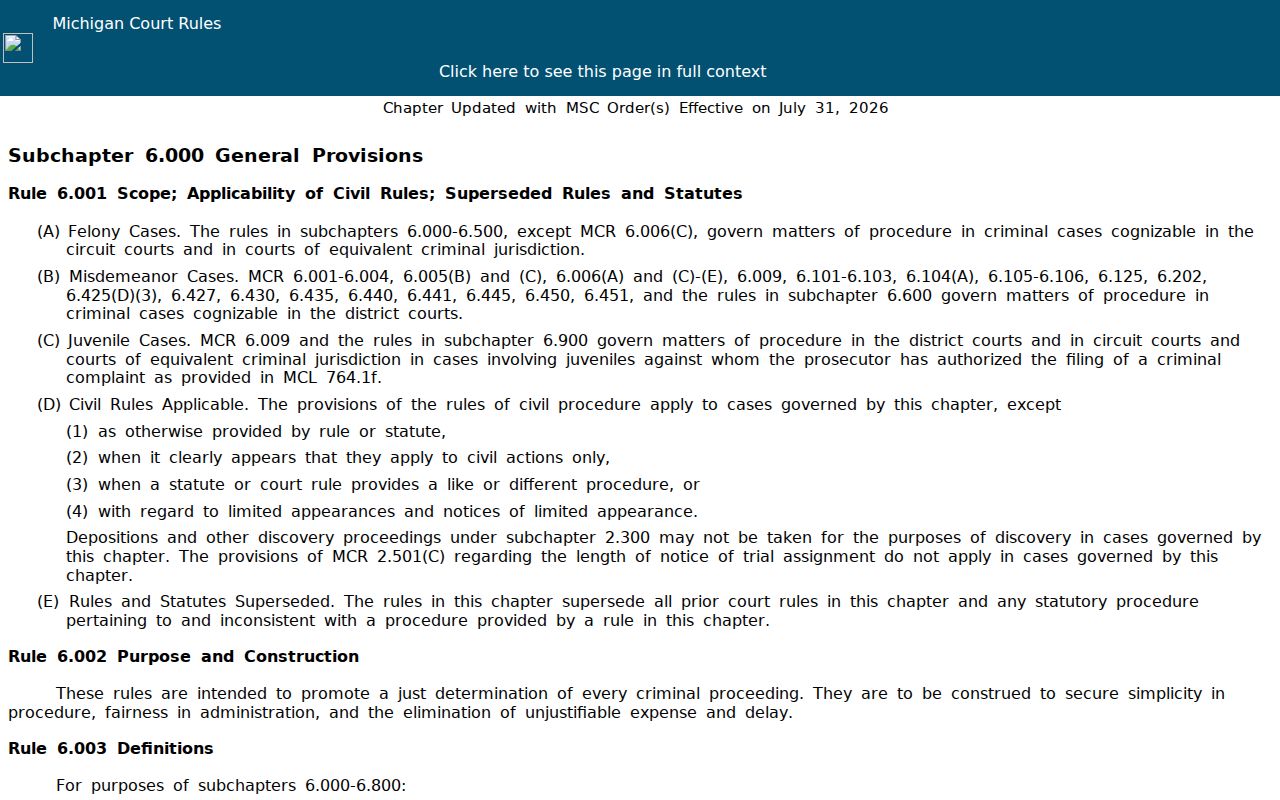
The rules above are what a Branch County judge applies. Quoting the rule number when you call helps.
How a Bench Warrant Is Issued
The judge issues a bench warrant from the bench or by written order once the missed obligation is on the record. No new complaint is filed. The underlying case already exists. The order enters the court's system and may be entered for law-enforcement access in the statewide network, which means any officer can act on it. From there, the warrant stays open until something changes it. An arrest followed by an appearance changes it. So does a recall, a quash, or a reset ordered by the judge. Nothing else clears a Branch County warrant, and time alone never retires one.
Branch County Uses Bench Warrant, Not Capias
Terminology trips people up when they call a Branch County clerk. The county's current official pages use "bench warrant," "criminal warrant," "arrest warrant," and "failure to appear." The words "capias" and "capias pro fine" appear nowhere in current county materials, even though other states and older documents use them for the same idea. Don't let that gap cost you time. Use the county's own vocabulary on the phone. Ask whether a bench warrant or a failure-to-appear hold is active, then ask the clerk to name the clearing step: recall, quash, reset, arraignment, or payment. Precise words get precise answers.
Bench Warrant vs Arrest Warrant
Both orders authorize custody. They just start in different places. An arrest warrant follows a probable-cause review of an alleged offense, while a bench warrant in Branch County follows a missed obligation in a case already underway, and that difference tells you who to call first.
| Feature | Bench Warrant | Arrest Warrant |
|---|---|---|
| Trigger | Missed appearance or court condition | Complaint and probable cause of an offense |
| Who Issues It | The judge on the existing case | A judge or magistrate after review |
| Underlying Case | A case the person was already in | A new or newly charged offense |
| How It Clears | Appear, recall, quash, or comply | Surrender, bond, or court appearance |
The probable-cause side of the split sits on the Branch County arrest warrants page. The two orders are easy to confuse at first glance.
Branch FOC Warrant vs Felony Nonsupport
The Friend of the Court page draws a line that matters. A civil bench warrant can follow a missed show-cause hearing on unpaid support or a parenting-time violation. The person contacts the case manager, and an agreement can lead to the warrant being recalled and removed. Felony nonsupport is different. That is a criminal warrant, and the Friend of the Court cannot issue or resolve it; those cases belong to the issuing prosecutor or the Michigan Attorney General. Support enforcement lists two lines: 517-279-4314 for the general office and 517-279-5173 for bench warrants. Call the right number for your Branch County situation.
How to Resolve a Branch County Bench Warrant
Resolution runs through the issuing court in every Branch County case. Call before you travel, since offices close at published times and some courtrooms ban phones.
- Confirm the warrant and the court: 3-A criminal 517-279-4329, 3-A traffic 517-279-4328, Circuit 517-279-4304, or Friend of the Court 517-279-5173.
- Ask whether the court wants a scheduled appearance, a motion to recall or quash, a bond, or a payment.
- Raise Michigan Court Rule 6.105 voluntary appearance if you plan to walk in within a year of issuance.
- Resolve the underlying obligation, whether that is an appearance, a payment, or a compliance agreement.
- Ask for written or phone confirmation that the warrant no longer shows as active.
Caution: A bench warrant does not expire on its own, and it can surface at a traffic stop, a courthouse door, or any other contact with law enforcement.
Recall, Quash, Reset: Three Different Acts
Branch County clerks use precise words, and the word they choose tells you what actually happened to the warrant.
- Recall
- The issuing court removes the warrant from active status, often after an appearance or agreement.
- Quash
- A judge sets the warrant aside by judicial order, usually on a motion.
- Reset
- The court schedules a new appearance or compliance date in place of the missed one.
- Voluntary appearance
- Presenting to the issuing court on your own rather than waiting to be picked up.
- Civil contempt
- A court enforcement power for disobedience or nonpayment, described on the Branch traffic page.
Ask which of the three the Branch County court intends before you act, and ask how you will confirm it happened. A payment receipt is not a recalled warrant.
Which Branch County Court Issued It
Start with the paper in your hand. A bench warrant stays tied to the Branch County court that opened the case, and that is where a recall has to happen. Branch County sorts its cases by type. So the right office depends on the charge. Misdemeanors sit in the 3-A District Court. A felony begins there as well, then moves to the 15th Circuit Court after bindover. A civil traffic infraction goes to the 3-A traffic clerk. A criminal traffic charge belongs with District criminal instead. Support and parenting-time matters go to the Friend of the Court. The county directory keeps those lines separate on purpose, and the Sheriff is the wrong first call because deputies execute orders rather than recalling them. Call the issuing court.
No Branch Walk-In Warrant Docket Exists
Branch County has no drop-in warrant window. There is no same-day recall docket. Nobody is promised a hearing without an appointment. The courthouse closes in the late afternoon on weekdays, the 3-A office lists its own closing time, and the Circuit office shuts for an hour at midday. You call first and travel second. Ask where to report and what time to arrive. Ask what to bring. Ask whether a lawyer should file or attend. If the answer involves a courtroom, note that phones are prohibited on the second floor and attire rules apply. The county also posts a construction and parking notice for Hudson and Pearl, so give yourself extra time there. Work the clearing steps in the county warrant records overview around whatever office hours you are given.